MRI Scan UK: Private Options, NHS Waits and What to Expect
Quick Answer
An MRI scan UK guide should help you decide whether to wait for NHS imaging or pay privately for faster access. In many cases, private MRI offers quicker appointments, digital results and more booking flexibility, while NHS scans remain the right choice for urgent pathways and funded care.
If you are searching for an MRI scan UK patients can access quickly, the main decision is usually time, cost and care pathway. NHS imaging is appropriate for many people, but waiting times can be long when symptoms are uncomfortable or a diagnosis is being delayed. Private scanning can offer faster appointments, digital reports and more flexibility, especially for people in London who need to get back to work, sports or specialist treatment planning. This guide explains how an MRI scan UK pathway works, what the NHS and private options look like, and how to choose the most practical route for your situation. If you want more context on booking, you can also read our private MRI scan guide before deciding.
What Is an MRI Scan Used For?
An MRI scan UK patients are offered is a detailed imaging test that uses a strong magnetic field and radio waves. It helps doctors look inside the body without radiation, which is why it is commonly used for soft tissues, joints, the brain, the spine and abdominal organs. In practice, an MRI scan UK appointment may be used to investigate pain, neurological symptoms, injury, inflammation or possible organ disease.
This matters because MRI shows structures that X-rays often miss. For example, it can help assess a slipped disc, a torn ligament, a brain symptom that needs clarification, or a bile duct or pancreatic concern. If your symptoms involve the head, our headache red flags guide explains when imaging should be discussed with a clinician. If your symptoms point to the upper abdomen, our pancreatic assessment guide may also help you understand why an MRI is sometimes requested.
The best MRI scan UK pathway depends on the body area and the question being asked. A GP, consultant, physiotherapist or specialist may request it when a clearer diagnosis is needed. Moreover, people often choose MRI because it can provide a more complete picture before treatment starts.
Key uses include:
- Brain and head symptoms
- Spine pain and nerve irritation
- Joint and soft tissue injuries
- Abdominal or biliary concerns
- Follow-up checks after treatment
For a plain-language overview of MRI basics, the NHS explains the test on NHS 111 Wales.
For a clear UK-based overview of what happens during an MRI appointment, watch this short guide from Bristol NHS Foundation Trust.

How does an MRI scan work?
An MRI scan UK patients have is non-invasive and usually painless. You lie still while the scanner collects images, and the team may ask you to hold your breath for short periods. The scan itself is often quiet at the start of the appointment, but the machine can make knocking sounds during imaging.
Because the scan uses magnets, patients are screened carefully for implants, metal fragments and some devices before the appointment begins. That safety check is essential and usually takes only a few minutes.
NHS MRI Scans vs Private MRI Scans in the MRI scan UK Pathway
The NHS and private routes both have value, but they work differently. An MRI scan UK patients receive through the NHS is usually arranged after a GP or consultant referral, and it is covered by the health service. A private MRI is self-pay or insurer-funded, and it is usually booked directly with a provider.
In simple terms, NHS imaging is best when the pathway is clinically funded and the timing is acceptable. Private imaging is often better when speed, convenience and fast reporting matter. Many people choose a private MRI scan UK option because they want to avoid a long delay before seeing what is causing the pain, numbness, headaches or abdominal symptoms.
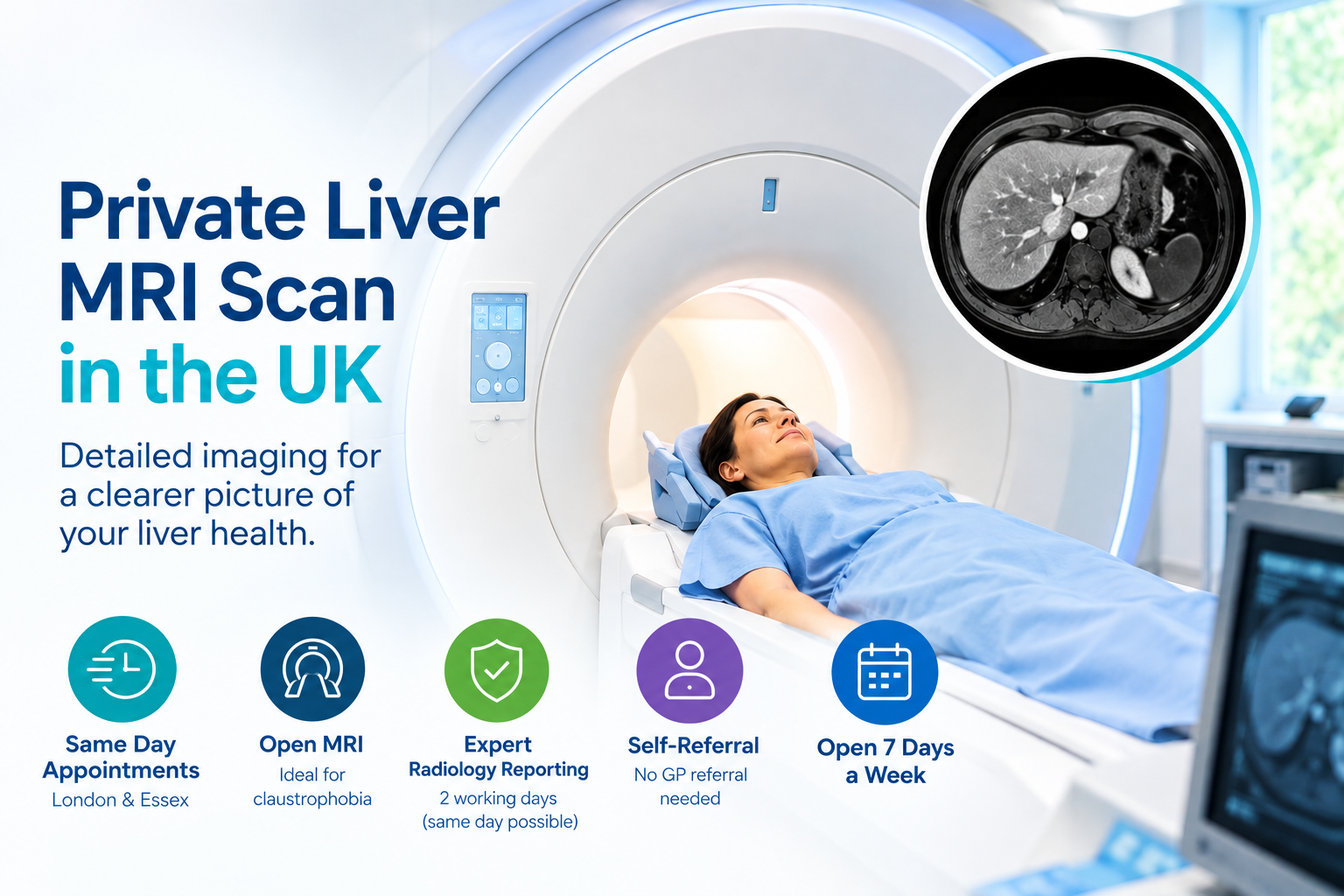
Private scans can also help when you need results sent digitally to your GP, consultant or physiotherapist. That can be useful if treatment is already waiting on the imaging report. If you are comparing providers, our MRI scan near me guide explains how to judge location, reporting and access. You can also review open MRI options in London if claustrophobia is part of your decision.
Is a private MRI better than NHS?
A private MRI is not automatically better than the NHS. It is better for some people because it is faster, easier to schedule and often easier to coordinate with follow-up care.
The NHS is still the right route when you need funded treatment, emergency assessment or a specialist-led pathway. Therefore, the best choice depends on urgency, budget and whether you need speed more than referral management.
How Long Are MRI scan UK Waiting Times in the UK?
Waiting times vary by region, specialty and how urgent the referral is. In the NHS, an MRI scan UK appointment may be scheduled quickly for urgent cases, but routine scans can take much longer when demand is high.
That is why many patients start asking about private imaging when symptoms are affecting sleep, work, sport or day-to-day life. A private MRI scan UK service may give you a much shorter route to imaging because you are booking directly rather than joining a longer referral queue.
The real issue is not only the scan itself. It is the time spent waiting for the next decision. A delayed report can postpone physiotherapy, consultant review or further tests. As a result, some patients choose private imaging even when they still want NHS follow-up afterwards.
If your concern is pain, mobility or a suspected spinal issue, our thoracic spine MRI guide explains why certain symptoms are often investigated with MRI rather than waiting to see if they settle.
A sensible approach is to ask:
- Is the symptom stable or worsening?
- Do I need a faster diagnosis to start treatment?
- Will the report be shared with my NHS clinician?
- Can I afford the self-pay route?
That decision framework is often more useful than trying to compare every MRI scan UK provider on price alone.
Can You Pay for Your Own MRI scan UK Appointment?
Yes, you can usually pay for your own MRI scan UK appointment. This is often called self-pay, and many patients use it when they want faster access, a specific body-part scan or a report they can share quickly with a clinician.
Self-pay is common for people with back pain, sports injuries, head symptoms, abdominal concerns or claustrophobia. It is also useful when you want to avoid waiting for a referral cycle to move through the NHS system. If you are unsure what the process looks like, our private MRI scan near me page explains how fast appointments and digital results typically fit together.
Some providers allow self-referral for selected scans, while others may still ask for clinical information first. That is not a barrier; it is a safety step. The imaging team needs to confirm the correct scan, the right protocol and any checks related to implants or prior surgery.
A good private MRI scan UK service should be transparent about:
- What body area is being scanned
- Whether contrast is needed
- How the report is delivered
- What preparation is required
- Whether the images can be shared with your doctor
If you need a more comfortable scanner, you may also want to compare open MRI availability. Our London open MRI article covers that option in more detail.
What does self-referral mean?
Self-referral means you contact the imaging provider directly rather than waiting for a GP or consultant to organise the scan. It can simplify access, especially when you already know which area needs imaging.
However, self-referral does not replace medical assessment. If your symptoms are urgent or severe, you should still seek medical advice first.
How Much Does an MRI scan UK Cost?
The cost of an MRI scan UK patients pay for privately depends on the body area, whether contrast is required, and how the results are reported. Some scans are simpler than others, so prices can vary meaningfully between a brain scan, a spine scan and a more specialised abdominal study.
If you are comparing options, look beyond the headline price. A low number is less helpful if it does not include reporting, support or image sharing. Therefore, ask whether the quote covers the scan, the radiology report and digital delivery of results.
The safest way to compare an MRI scan UK price is to compare the full package. That usually includes:
- Scan appointment
- Screening and clinical checks
- Radiologist reporting
- Digital access to results
- Copies for your GP or specialist
For a broad health-service overview, the Bupa MRI scan guide and the NHS 111 Wales entry both explain the procedure clearly, but exact private prices should always come from the provider at the time of booking. We avoid quoting figures here because prices change and depend on the scan type.
If you are booking with MRI Plus, ask the team whether the scan you need is standard, contrast-enhanced or tailored to a specific question. That will help you compare the real value of an MRI scan UK appointment rather than just the sticker price.
Do Private MRI Results Work With NHS Care?
Yes, private MRI results can usually support NHS care. A private report can be shared with your GP, consultant or physiotherapist, which often helps the next stage of treatment move forward.
That is one reason many people choose a private MRI scan UK pathway. They want a faster diagnosis, but they still want their ongoing treatment to remain within the NHS. In many cases, a private report becomes the evidence needed to unlock referral, medication changes or specialist review.
The most useful private MRI scan UK service is one that delivers reports in a clear format and gives you access to the images. That makes it easier for another clinician to review the findings and act on them.
When you book, ask whether the provider can send:
- A radiology report
- The image files or secure image access
- A summary for your GP or consultant
This is especially important if you are being investigated for a head symptom, a spinal issue or an abdominal problem where more than one clinician may need to review the scan. In that situation, a fast scan is only half the value. The report must also be easy to use.
MRI, CT and Ultrasound: What Is the Difference in the MRI scan UK Decision?
MRI, CT and ultrasound answer different clinical questions. MRI is usually best for soft tissue detail, CT is often used for bones, trauma and some urgent conditions, and ultrasound is commonly used for accessible superficial or abdominal structures.
That means MRI is not always the “best” scan. It is the best scan when the doctor needs detailed soft tissue contrast or a closer look at the brain, spine, joints or some abdominal organs. If the clinical question is different, another test may be more appropriate.
A simple way to think about the MRI scan UK decision is this:
- MRI: detailed soft tissue imaging
- CT: fast imaging, often used in urgent settings
- Ultrasound: real-time imaging for selected areas
So, is an MRI better than a CT scan? Not always. It depends on the symptom, the urgency and what the doctor needs to see. For abdominal and biliary questions, MRI can sometimes be especially helpful, which is why MRCP is a valuable option in the right clinical context.
If you are unsure which scan you need, a good provider should help you choose the right pathway rather than selling you the most expensive one. That is the standard patients should expect from any MRI scan UK service.
How to Book a Private MRI Scan With MRI Plus
Booking a private MRI scan UK appointment with MRI Plus is designed to be straightforward. The process usually starts with your symptoms, the body area you need scanned and any prior clinical advice.
First, identify the right scan. That might be a brain MRI, thoracic spine MRI, MRCP or another focused study. Next, the team checks whether self-referral is suitable and whether you need any preparation. After that, you can arrange the appointment and receive your instructions before the day.
This is where a clear booking process matters. Patients often feel better when they know exactly what happens next, especially if they have pain, anxiety or claustrophobia. If comfort is a concern, our open MRI guide for London can help you understand whether a more spacious scanner is the better fit.
A good MRI scan UK booking experience should include:
- Fast confirmation
- Clear screening questions
- Practical prep instructions
- Digital report delivery
- Easy sharing with another clinician
If you are still deciding, you can also read MRI Plus health and MRI insights for more patient guidance before you book. The goal is simple: make the process clearer, quicker and easier to manage.
Key Takeaways
- An MRI scan UK pathway can be via the NHS or private self-pay, and the best option depends on urgency, budget and clinical need.
- Private MRI is often chosen for faster access, flexible booking and digital results that can be shared with NHS or private clinicians.
- MRI is especially useful for the brain, spine, joints and some abdominal concerns because it gives detailed soft tissue images.
- MRI is not always better than CT; the right scan depends on the medical question, not just the technology.
- A good private provider should explain preparation, reporting and sharing of results clearly before you book.
Frequently Asked Questions
How much does an MRI cost in the UK?
Private MRI costs in the UK vary by scan type, body area and whether the report is included. The best way to compare value is to ask for a full quote that includes the scan, radiology reporting and digital results, rather than comparing a headline price alone.
How long is the wait for an MRI scan on the NHS?
NHS MRI waits vary by location and clinical urgency. Some urgent cases are seen quickly, while routine scans may take much longer, especially when demand is high. If the delay is affecting pain, treatment planning or anxiety, a private MRI scan UK option may be worth considering.
Is a private MRI better than NHS?
A private MRI is better for some people because it is faster and easier to schedule. The NHS is still the right choice when you need funded care, urgent assessment or an established hospital pathway, so the best option depends on your clinical situation.
Is an MRI better than a CT scan?
Not always. MRI is usually better for soft tissues, the brain, spine and joints, while CT is often better for fast imaging and some urgent conditions. The right test depends on the body area and the question your clinician needs answered.
Can I book an MRI scan UK appointment without a GP referral?
In many cases, yes. Some private providers accept self-referral for selected scans, although screening questions and clinical checks still apply. If your symptoms are severe or urgent, you should still speak to a clinician first.